

Thanksgiving afternoon, and the kitchen counter has disappeared under three serving platters, a stack of dessert plates, and a gravy boat waiting for a burner to free up. The good glassware is still in a box in the basement closet where it has lived since the last move. Somebody wants to set up coffee, and there is no surface left in the house that is not already holding food. That specific bottleneck is the reason dining room cabinets exist, and it shows up in the same houses every holiday until somebody solves it.
The encouraging part is that this is one of the most solvable problems in a house, because dining room cabinets are judged on measurable things: dimensions, storage type, and construction. At Jaron’s Furniture Outlet, our team helps South Jersey households sort through those decisions every week, in Bordentown and Lumberton and across Burlington County. This guide covers the cabinet types and what each one actually does, how to size and place one, what separates real construction from filler, which storage features are worth paying for, how to coordinate the finish with what you already own, and a roundup of seven standout picks.
Get Your Dining Room the Storage It Has Always Needed
Jaron’s Furniture Outlet stocks dining storage across a wide range of styles and price points at our Bordentown and Lumberton showrooms. Open the drawers, check the joinery, and let our team handle delivery and setup, with local service you can actually reach afterward.
Key Takeaways
- The labels overlap in the real world: Buffet, sideboard, credenza, and server are used loosely across manufacturers, so judge by dimensions and storage type rather than by the name on the tag.
- Depth is the number that causes problems: Most dining storage runs 16 to 20 inches deep, and that projection is what determines whether chairs can still be pulled out behind it.
- Construction beats appearance: Dovetailed drawer boxes, full-extension glides, and a solid back panel predict a twenty-year piece far better than the finish does.
- A dining cabinet rarely stays in the dining room forever: Entryway console, media console, coffee bar, and office credenza are all common second lives, which protects the investment.
Types of Dining Room Cabinets and What Each One Actually Does
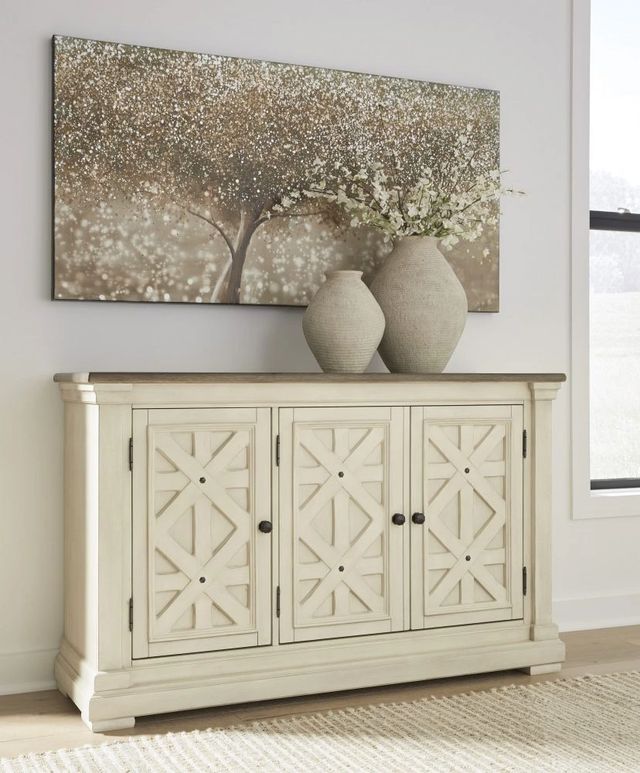
The naming in this category is genuinely confusing, and a lot of that confusion comes from retailers using terms interchangeably. Here is the practical version.
- Buffet: Typically taller, often on legs, built for serving food at standing height. Enclosed cabinet storage below, sometimes drawers on top.
- Sideboard: Runs lower and longer than a buffet, closer to the floor, with more horizontal surface. Historically the piece against a dining room side wall.
- Credenza: Traces back to office and mid-century furniture. Usually low, often with sliding or flat-front doors and minimal ornament.
- Hutch: The upper display unit only, designed to sit on a base. Never a standalone piece.
- Buffet with hutch: A base cabinet plus the upper display unit, sold together, delivering both storage and display in one footprint.
- China cabinet: Enclosed glass display above and closed storage below, built specifically for dishware and stemware.
- Curio cabinet: Glass on multiple sides for display from several angles, usually shallow and tall, with little closed storage.
- Server: A compact, often narrow piece meant to hold serving items close to the table. Frequently the right answer in a small dining area.
- Bar cabinet: Configured for bottles, stemware, and barware, sometimes with a pull-out serving surface.
- Accent chest used as dining storage: Not sold as dining furniture, but frequently the best proportioned option for a tight space.
What each one stores best follows from the shape. Buffets and sideboards excel at serving pieces, linens, and flatware, since drawers and enclosed shelves handle bulk. China cabinets and curios excel at stemware and heirloom china, because glass doors protect from dust while keeping the pieces visible. Bar cabinets handle bottles and glassware with dedicated racks and taller interior clearance.
In actual retail listings, these terms blur constantly. A piece marketed as a server in one catalog is a sideboard in another, and a credenza in a third. Ignore the label and read three numbers: height, width, and depth. Those tell you what it does far more reliably than the name.
The One-Sentence Decision Rule
- Need a standing-height surface for serving food at gatherings, choose a buffet.
- Need maximum enclosed storage on a long wall, choose a sideboard.
- Need low-profile storage that doubles as a media or entry piece, choose a credenza.
- Need to display and protect china and crystal, choose a china cabinet.
- Need display visible from multiple sides in a corner, choose a curio.
- Need storage in a small or narrow dining area, choose a server.
- Need bottles, glassware, and a mixing surface, choose a bar cabinet.
Sizing and Placement: Getting Dining Room Cabinets to Fit the Room
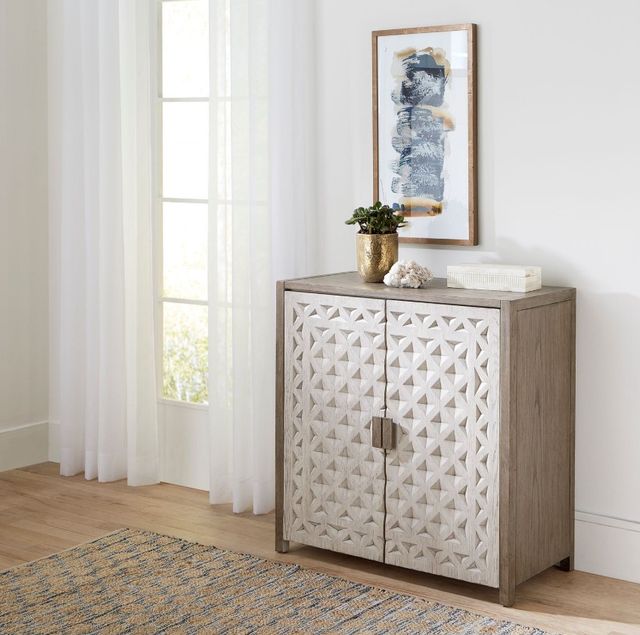
Numbers first, because vague advice causes returns.
Widths generally run from about 32 inches on a compact server to 72 inches or more on a generous sideboard, with 48 to 60 inches covering most of the market. Depth runs 15 to 20 inches on most pieces, with china cabinets sometimes deeper. Height is where the categories separate: a low sideboard or credenza commonly sits 30 to 34 inches tall, a standard buffet 34 to 38 inches, and a full china cabinet or buffet with hutch 72 to 84 inches.
Clearances decide whether the piece works:
- Measure the distance from the dining table edge to the wall where the cabinet will go.
- Subtract the cabinet depth from that number.
- Leave at least 36 inches between the table edge and the cabinet face so a seated diner can push back and stand.
- Add another 6 to 12 inches if that gap is also a walking path around the table.
- Confirm you can open a cabinet door and extend a drawer fully without hitting a chair back.
If the math does not work, a shallow-depth piece at 15 or 16 inches often rescues the room where an 18 or 20 inch cabinet would not.
Proportion to the table matters aesthetically. A good rule is that the cabinet should be roughly two-thirds to three-quarters the length of the dining table, or wider. A 40-inch server behind an 84-inch table looks undersized and unresolved. A 72-inch sideboard behind a 48-inch round table overwhelms it.
Placement options and their trade-offs:
- The long wall behind seating: The classic position, and the one that demands the 36-inch clearance most.
- An end wall: Often the better choice in a narrow room, since it does not intrude on the seating perimeter.
- An open-concept transition zone: A low cabinet acting as a soft divider between dining and living areas.
- A bay or window wall: Works only if the cabinet height sits below the sill, so measure the sill height first.
Look up and look behind before deciding. Ceiling height determines whether a hutch or a china cabinet fits, and crown molding can prevent a tall piece from sliding flush to the wall. Wall art, window sills, light switches, thermostats, and outlets all sit at heights that a cabinet back can block. An outlet behind a cabinet is a genuine problem if you plan to use interior lighting.
Check delivery access the same way you would for a sofa. Doorway widths, hallway turns, and stairwell diagonals decide everything. Worth knowing: tall china cabinets and buffets with hutch usually ship as two pieces and go in easily, while a one-piece 72-inch sideboard is a single rigid object that has to clear every turn intact.
Mock up the footprint with painter tape on the floor, then tape a vertical height marker on the wall using a strip of cardboard cut to the cabinet height. The floor tape shows you clearance. The height marker shows you sightlines, which is what tells you whether the piece will block a window, crowd a picture frame, or make the room feel shorter than it is.
Read More: 5 Ways to Position a Table in a Dining Room | How to Choose the Perfect Wooden Dining Table for Your Home
Materials and Construction: What Separates a Cabinet That Lasts
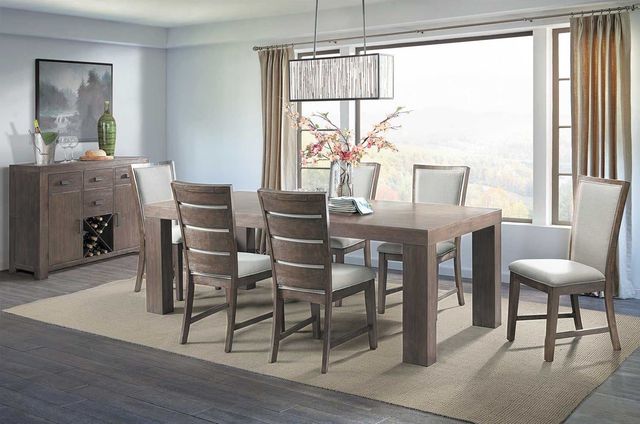
This is where the money either goes into the piece or into the marketing.
Solid hardwood in oak, maple, cherry, acacia, or mango is repairable and refinishable, holds screws well, and carries weight without deflection. It costs more and it responds to humidity changes. Hardwood veneer over an engineered core is legitimate construction, not a compromise, and on a wide cabinet top it stays flatter than a solid glued panel would. MDF takes paint beautifully and is dense and heavy, though standing water will swell it. Particleboard is the budget tier; judge it by thickness and by whether edges are sealed. Laminate is a printed surface that resists scratches and cannot be refinished.
Joinery and case construction tell you the rest:
- Dovetailed drawer boxes: Interlocking joints that survive decades of loaded linen drawers.
- Mortise and tenon or doweled frames: Stronger than stapled butt joints, especially on legs and door frames.
- Corner blocking: Glued and screwed blocks that keep the case square under load.
- Dust panels between drawers: Add rigidity and keep contents clean.
- Back panel attachment: A thick back set into a groove beats a thin panel stapled to the outside.
- Solid versus hollow-core shelves: Hollow shelves sag under stoneware; solid or thick engineered shelves do not.
Hardware is the part you touch every day. Full-extension glides let you reach the back of a drawer. Soft-close hinges and runners eliminate slamming, which is the main cause of loosened door and drawer fronts over ten years. Adjustable shelf pins with metal sleeves outlast bare holes drilled in particleboard. Doors should align with even reveals when closed, and a door that sits crooked on the floor model will sit crooked in your dining room.
Glass deserves specific attention on display pieces. Tempered glass breaks into blunt granules rather than shards and is the safer choice in a house with kids. Framed doors protect the glass edge; frameless doors look lighter but expose it. Mullion detailing changes the style read entirely, and a mirrored back doubles the apparent depth of a display while showing every fingerprint.
Finish durability follows the same logic as any case goods. Catalyzed finishes cure hard and resist water rings from a sweating glass. Open-pore and distressed finishes hide wear by design but collect dust in the grain. High-sheen finishes show every smudge on a piece people lean against while serving.
Weight capacity and stability matter more here than in most furniture, because dining cabinets hold heavy, breakable things. Stoneware dinnerware for twelve is genuinely heavy, and adjustable shelves that flex under it will eventually fail. Anti-tip hardware is included with most tall pieces, and it belongs on the wall rather than in a drawer, especially with a china cabinet full of glass in a home with children.
The 60-Second Showroom Inspection
- Pull the top drawer completely out and look at the corners and the box material.
- Press down in the center of a shelf and watch for flex.
- Push sideways on the top corner of the case to check for racking.
- Open both doors and check whether the reveals stay even.
- Look at the back panel and how it is attached.
- Run a hand along the interior edges to see whether they are finished or raw.
Storage and Display Features Worth Paying For
Features change daily use, and some are worth the upcharge while others are decoration.
Interior storage features that earn their keep: adjustable shelving rather than fixed, felt-lined or velvet-lined flatware drawers that prevent tarnish and rattle, deep linen drawers sized for folded tablecloths, plate grooves and plate rails that hold dishes upright for display, stemware racks that hang glasses by the foot, wine bottle storage with proper cradles, and removable dividers you can reconfigure.
Display features that change the look: interior LED or puck lighting, touch dimmers, glass side panels that let light cross through the cabinet, mirrored backing that doubles apparent depth, and glass shelving that lets light reach the lower shelves instead of stopping at the first one.
Convenience features worth considering: touch-latch doors that eliminate visible hardware, cord management cutouts that let a buffet serve as a coffee station or a media console, locking doors for anything valuable, and heat-resistant or stone tops that tolerate a warm serving dish.
Protection for fine china, crystal, and silver is a legitimate reason to spend more. Enclosed glass display cuts dusting from weekly to seasonal, since airborne dust settles on open shelving continuously. Tarnish-resistant flannel lining in a silverware drawer genuinely slows tarnish on sterling and silverplate, which is the difference between polishing before a holiday and polishing every holiday.
Ranking Features by How Often You Use Them
- Adjustable shelving, used every time storage needs change.
- Full-extension drawer glides, used every single time you open a drawer.
- Deep linen or flatware drawers, used at every gathering.
- Enclosed doors versus open shelving, which decides how often you dust.
- Cord cutouts, used constantly if the piece serves coffee or holds electronics.
- Interior lighting, used when entertaining and mostly decorative otherwise.
- Mirrored backing, purely visual.
- Touch-latch hardware, pleasant but not functional.
For a frequent host, lighting, stemware racks, and a heat-tolerant top pay off several times a year. For an occasional host, that money is better spent on drawer construction and shelf strength, which you benefit from every day regardless of the calendar.
Style and Finish: Coordinating a Cabinet With the Room You Already Have
The instinct to match a dining set exactly is usually the wrong one, and matching poorly is worse than not matching at all.
Start by identifying the style family you already own:
- Traditional: Turned legs, raised panel doors, ornate molding, brass hardware.
- Transitional: Simplified traditional shapes, restrained molding, mixed metals.
- Farmhouse and modern farmhouse: Plank or shiplap detailing, painted bases, distressed tops, black or oil-rubbed hardware.
- Mid-century modern: Tapered legs, flat door fronts, warm walnut tones, minimal hardware.
- Industrial: Metal framing, reclaimed wood tops, exposed fasteners.
- Coastal: Whitewashed and light finishes, woven or cane detailing, relaxed proportions.
- Contemporary minimal: Flat fronts, no visible hardware, high-contrast finishes.
Deliberate contrast usually reads better than an attempted match. A painted cabinet against a wood dining set, or a dark cabinet in a light room, looks like a decision. A cabinet that is almost the same brown as your table looks like a mistake, because the eye reads the near-miss as a failure rather than a choice.
That is the key point about finish coordination against flooring and existing cabinetry: undertone matters more than shade. Wood tones carry a warm cast, with red, orange, or yellow in them, or a cool cast, with gray or ash. A warm cabinet several shades lighter than your warm floor reads as intentional layering. A cool gray-brown cabinet against a warm oak floor reads as wrong even when the values are close.
Hardware is the cheapest unifying tool available. Swapping pulls on a new cabinet to match the metals already in the room, whether that is the chandelier finish, the door hardware, or the kitchen pulls, ties the piece into the space for a modest amount. Measure the existing hole spacing before you order.
Styling the top surface follows a simple structure. Work in layers of different heights, keep at least a third of the surface empty so it still functions, and put a lamp on one end if the room is short on light. Above the cabinet, hang art or a mirror at a size that relates to the cabinet width, roughly two-thirds of it, and leave 6 to 10 inches between the cabinet top and the bottom of the frame.
The rule for matching versus contrasting: count the distinct wood tones already visible in the room, including the floor. If the room carries two or fewer, a contrasting cabinet adds welcome interest. If the room already carries three or more, choose a painted finish or a tone that repeats one already present, because a fourth wood tone is where a room starts to look accidental.
Read More: How to Find the Perfect Farmhouse Dining Room Set | How to Make a Grey Sectional Feel Warm and Inviting
Small Dining Rooms and Multi-Room Uses for Dining Cabinets
Small dining areas are the norm in a lot of South Jersey housing, and there are real strategies rather than just buying less furniture.
- Choose a shallow-depth sideboard at 15 or 16 inches instead of a standard 18 to 20.
- Use a narrow server, which is designed for exactly this problem.
- Pick a piece on legs so you can see floor underneath it, which reads as more space.
- Favor lighter finishes and glass doors, both of which reduce visual weight.
- Go vertical with a slim curio instead of horizontal with a wide sideboard when wall length is the constraint.
In an open-concept room, a low cabinet placed perpendicular to the wall becomes a soft divider between dining and living zones. It defines the space without blocking sightlines the way a full-height piece or a wall would, and it gives you a serving surface facing the dining side and a console surface facing the living side.
The most underrated argument for buying a good dining cabinet is that it rarely stays a dining cabinet forever. Common second lives include an entryway console with a bowl for keys and drawers for gloves, a media console under a wall-mounted television, a home office credenza for files and a printer, a coffee bar or bar station in a kitchen or family room, and bedroom storage where a dresser would be too deep.
If you think a piece may be repurposed later, check three things before buying: whether the depth suits a television and components, whether there are cord cutouts or whether the back panel can be drilled, and whether shelf spacing accommodates electronics or standard storage bins. Renters and frequent movers should also note that two-piece hutch designs and lighter cabinets relocate far more easily than a heavy one-piece sideboard, which is a legitimate reason to choose one over the other.
Dining Room Cabinets Compared: Which Style Fits Your Home
| Cabinet Type | Typical Size | Primary Function | Storage Type | Serving Surface | Price Position and Best Fit |
|---|---|---|---|---|---|
| Buffet | 34-38 in tall, 48-72 in wide | Serving at standing height | Doors plus drawers | Yes, standing height | Mid range, frequent hosts |
| Sideboard | 30-34 in tall, 54-72 in wide | Maximum enclosed storage | Doors, deep drawers | Yes, lower height | Entry to mid, long walls |
| Credenza | 28-32 in tall, 48-72 in wide | Low-profile storage | Flat or sliding doors | Yes, low | Mid range, open concept |
| Buffet with hutch | 72-84 in tall | Storage plus display | Enclosed below, glass above | Yes, at the base | Mid to premium, formal rooms |
| China cabinet | 72-84 in tall, 40-60 in wide | Protected display | Glass display, closed base | Limited | Premium, china collections |
| Curio cabinet | 70-80 in tall, 28-36 in wide | Multi-angle display | Glass shelves, glass sides | No | Mid range, corners |
| Bar cabinet | 36-72 in tall, 30-48 in wide | Bottles and barware | Racks, bottle storage | Often a pull-out | Mid to premium, entertainers |
| Server | 32-36 in tall, 32-48 in wide | Compact serving storage | Drawers, small cabinet | Yes, compact | Entry to mid, small rooms |
Read the table by starting with your room and your collection, not your style preference. A small dining area with everyday dishware is a server or a shallow sideboard, full stop. A formal dining room with inherited china is a china cabinet or a buffet with hutch, since protection and display are the actual job. A wide open-concept space that needs a zone divider and a lot of closed storage is a credenza or a long sideboard.
A dining cabinet solves real storage and serving problems, and it also claims floor space you cannot get back and commits the room to a style for years. Whether that trade is worth making depends almost entirely on how often the room gets used and what you need to store. Here is the honest accounting.
Dining Room Cabinets Pros and Cons: Is One Right for Your Space
Pros
It ends the counter bottleneck:
A serving surface at the right height turns a chaotic holiday meal into a manageable one.
Closed storage where there is none:
Most dining rooms have zero built-in storage, and linens and serving pieces have to live somewhere.
Heirlooms stop hiding in boxes:
Glass display keeps inherited china visible and protected instead of packed in a basement closet.
The room finally reads finished:
A tall or long piece against a bare wall gives a dining room the visual weight a table alone cannot provide.
The purchase survives a redecoration:
Few furniture categories relocate as easily into an entry, an office, or a family room.
Cons
Floor space is the real price:
A cabinet plus the 36 inches of clearance in front of it consumes more square footage than the dimensions suggest.
It costs more than shelving:
Open wall shelves deliver storage for a fraction of the money if display and dust protection do not matter to you.
Glass and wood ask for upkeep:
Glass doors show fingerprints daily and wood tops show water rings without a coaster habit.
What South Jersey Dining Rooms Have in Common
Housing in Burlington County pushes back on dining furniture in ways a national buying guide never mentions. Bordentown’s historic district is full of eighteenth and nineteenth century rowhouses and colonials where the dining room is a genuinely small square room, the doorways are frequently under 32 inches, and the plaster walls sit over lath rather than studs on a predictable 16-inch layout, which changes how a tall cabinet gets anchored. Much of Lumberton, Mount Laurel, and the surrounding townships is postwar and later construction, including 1970s bi-levels where the dining area is a half-open extension of the living room and a low credenza divides the two better than any wall, and newer development homes with open-concept dining where a long sideboard finally has a wall to live on. Add the humidity that comes with sitting between the Delaware River and the coastal plain, where summer indoor humidity runs high in homes without whole-house dehumidification, and material choice stops being cosmetic.
Here is the placement detail our delivery crews check on every dining cabinet install in older South Jersey homes: look at what is on the wall behind the piece before you commit to a depth, because baseboard convectors and cast-iron radiators are still the primary heat in a lot of these houses, and a cabinet pushed flat against a convector both blocks the heat the room needs and bakes the finish and the glue joints from behind all winter. Leave a couple of inches of air behind the piece, and if the convector runs the full wall, plan the cabinet for a different wall entirely.
- Bordentown historic homes: Measure the doorway first, and favor two-piece hutch designs over a one-piece 72-inch sideboard.
- Plaster and lath walls: Locate a real stud for anti-tip anchoring rather than trusting a drywall anchor in plaster.
- 1970s bi-levels: A low credenza perpendicular to the wall divides the dining and living zones without closing the room in.
- Newer open-concept homes: A long sideboard on the dining side wall handles both storage and buffet service for larger gatherings.
- High summer humidity: Veneer over engineered core stays flatter than wide solid panels, and a dehumidifier protects both.
- Basements used for storage: Bring the china upstairs into a display cabinet, since basement humidity is hard on paper labels, felt, and packing materials.
The Best Dining Room Cabinets at Jaron’s Furniture Outlet
Each pick below was chosen against the framework above: construction you can inspect, storage that matches a real need, and dimensions that suit a specific kind of room. Come open the drawers and check the shelf flex before you decide.
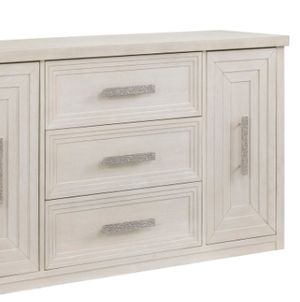
Elements International Avalanche Antique White Server
Shop Dining Room Sideboards & Buffets
Best for small dining rooms. A server is the format built for exactly the space problem described earlier, keeping storage and serving surface close to the table without claiming the depth a full sideboard demands. The antique white finish does double duty, brightening a small or interior dining room and reducing visual weight so the piece does not close the space in. Painted finishes also sidestep the wood-tone matching problem entirely, which is useful in a room that already carries a table, a floor, and trim in three different woods. It suits a Bordentown rowhouse dining room or any tight eat-in space.
Top Features
- Server proportions: Compact width and depth that suit small dining rooms and tight clearances.
- Antique white finish: Brightens the room and reduces perceived bulk.
- Paint over wood tone: Avoids the near-miss problem of matching an existing wood finish.
- Serving surface at the right height: A usable top for platters and a coffee station during gatherings.
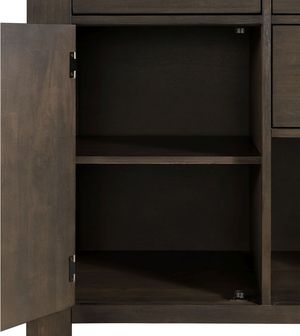
Elements International Grady Brown Server
Shop Dining Room Sideboards & Buffets
Best warm-wood value. Mid-tone brown is the most forgiving finish family in dining furniture, since it hides both the dust that shows on dark pieces and the scuffing that shows on light ones, and it coordinates naturally with the oak and hickory flooring common across Burlington County. The server format keeps the footprint modest, which matters in a dining area that also has to accommodate chairs pulled back from the table. Check the drawer glides and the shelf thickness in the showroom using the 60-second inspection, since those two details decide how this piece ages under a load of dinnerware.
Top Features
- Warm brown finish: A mid-tone that hides dust and scuffs better than lighter or darker extremes.
- Compact server format: Fits rooms where a full-length sideboard would crowd the seating perimeter.
- Coordinates with common flooring: Reads naturally against warm oak and hickory floors.
- Everyday storage: Drawer and cabinet space sized for serving pieces and flatware.
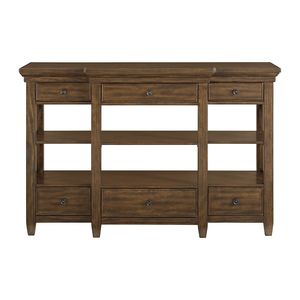
Elements International Phillipe Cherry Brown Sideboard
Shop Dining Room Sideboards & Buffets
Best for maximum enclosed storage. This is the sideboard format described earlier, running lower and longer than a buffet and delivering the most closed storage per foot of wall. The cherry brown finish carries a traditional warmth that suits older South Jersey homes with substantial trim, and it pairs well with the deeper wood tones common in dining sets from the same era. Because a long one-piece sideboard is a rigid object on delivery day, measure your doorway and any hallway turn before ordering. It suits a formal dining room with a long wall and a household that stores linens, serving pieces, and flatware.
Top Features
- Sideboard proportions: Lower and longer, which maximizes enclosed storage and surface area.
- Cherry brown finish: Traditional warmth suited to older homes with substantial trim.
- Full-length serving surface: Room to stage an entire buffet service at once.
- Linen and flatware capacity: Built for the bulk storage a dining room usually has nowhere to put.
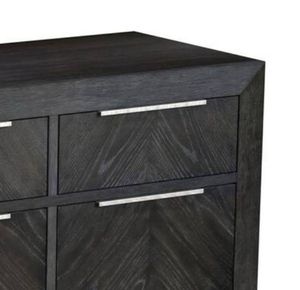
Elements International Transcend Charcoal Server
Shop Dining Room Sideboards & Buffets
Best modern look. Charcoal is the finish that reads contemporary without going stark, and it functions as a graphic anchor in a room with light walls and pale flooring. That makes it the deliberate-contrast option discussed earlier, since a dark cabinet against a light room is unmistakably a decision rather than a failed match. The server scale keeps it manageable in the open dining areas common in newer Lumberton and Mount Laurel construction. Charcoal does show dust, so this is a piece for a household that dusts rather than one that hopes the finish will handle it.
Top Features
- Charcoal finish: A contemporary dark tone that anchors a light room by contrast.
- Server footprint: Modest depth and width for open-concept dining areas.
- Deliberate contrast: Sidesteps wood-tone matching by not attempting a match at all.
- Modern styling: Clean lines that suit newer construction and minimal room schemes.
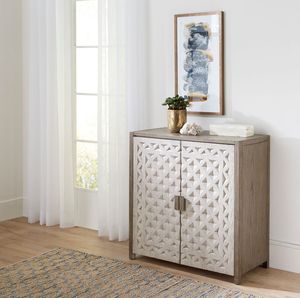
Liberty Furniture Chatfield Antique White/Tobacco Accent Console
Shop Dining Room Accent Cabinets
Best multi-room piece. A two-tone antique white and tobacco console is the most versatile piece in this lineup, because it works as dining storage today and as an entryway console, a media console, or a home office credenza later, which is exactly the durability argument made earlier. The two-tone treatment also solves a coordination problem: the painted body ties to trim and walls while the tobacco top ties to wood floors and the dining table. Confirm the depth against your television and components if a media role is likely. It suits renters, frequent movers, and anyone furnishing a house in stages.
Top Features
- Two-tone finish: A painted body plus a wood top, which coordinates with both trim and flooring.
- Console proportions: Shallow enough for entry halls and open-concept transition zones.
- Multi-room versatility: Moves easily into an entry, office, or family room later.
- Farmhouse and transitional fit: Suits the most common style directions in South Jersey homes.
Signature Design by Ashley® Bolanburg Distressed White Dining Room Server
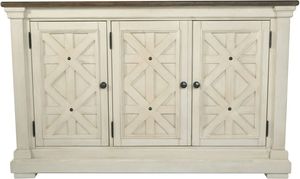
Shop Dining Room Sideboards & Buffets
Best farmhouse style. A distressed white finish hides wear by design, which is the practical case for the farmhouse look rather than just the aesthetic one, and it makes this a sensible choice for a household with kids where a smooth painted surface would show every knock. The Bolanburg is a well-established collection, so coordinating dining pieces are widely available if you want to build the room out over time. Distressed and open-pore finishes do collect dust in the grain, so plan on a soft cloth rather than a spray. It suits a modern farmhouse dining room or a busy family kitchen area.
Top Features
- Distressed white finish: Hides everyday wear by design rather than displaying it.
- Farmhouse styling: Fits the most requested dining style direction in the region.
- Server format: A manageable footprint for eat-in kitchens and smaller dining rooms.
- Established collection: Coordinating dining pieces available to complete the room later.
Signature Design by Ashley® Wildenauer Black/Brown Dining Room Buffet
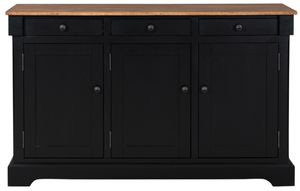
Shop Dining Room Sideboards & Buffets
Best for entertaining. This is a true buffet rather than a server or sideboard, which means the top surface sits at a comfortable standing height for serving food, exactly the distinction drawn at the start of this guide. The black and brown two-tone treatment gives you a dark, grounded base with warmer wood character above, so it holds its own against a large dining table without reading as one solid dark mass. Buffet height also makes the surface genuinely usable during a gathering rather than requiring guests to bend. It suits a household that hosts holidays and needs a real serving station.
Top Features
- True buffet height: A standing-height serving surface, which is the whole point of the format.
- Black and brown two-tone: A grounded dark base with warmer character above, avoiding a single heavy mass.
- Entertaining capacity: Built to stage a full serving spread during a gathering.
- Enclosed storage below: Room for serving pieces and linens out of sight between holidays.
Finding the Right Dining Room Cabinets for the Way You Live
The right type depends entirely on what you store and how you serve, since a server, a sideboard, a buffet, and a china cabinet solve four different problems. Dimensions and clearance decide whether the piece actually works in your room, and 36 inches between the table edge and the cabinet face is the number that matters most. Construction decides whether it lasts a decade or a generation, and drawer boxes, shelf thickness, and hardware tell you which one you are buying.
Come open the drawers yourself. Shop dining room cabinets online at Jaron’s Furniture Outlet or visit our Bordentown or Lumberton showroom to run the 60-second inspection on any piece that interests you. Our team knows the construction differences between the lines we carry and will ask about your room dimensions and your delivery path before recommending anything. Our own delivery and setup follows, including anti-tip anchoring on tall pieces, and local service and support stays available long after the sale. That is what an independent South Jersey retailer offers instead of a flat carton and a link to an assembly video.
Frequently Asked Questions about Dining Room Cabinets
A buffet typically sits taller, often on legs, and is built for serving food at standing height, while a sideboard runs lower and longer with more enclosed storage, and a credenza sits lowest with flat or sliding doors and traces its shape to office and mid-century furniture. Retailers use these terms loosely, so compare the height, width, and depth listed on the product page rather than trusting the label.
Dining room cabinets generally look best at roughly two-thirds to three-quarters of the dining table’s length, or wider, so a 72-inch table pairs well with a cabinet of about 48 to 60 inches. A cabinet much narrower than that reads undersized against the table, while one much wider than the table can overwhelm a small room.
China cabinets remain in style in formal and traditional dining rooms, and they are the most practical option for anyone who owns china or crystal worth protecting from dust. In smaller and more casual homes, a buffet with hutch or a slim curio delivers similar display and protection in a lighter, less formal form.
Solid hardwood is the most durable and the only material that can be fully refinished, while hardwood veneer over an engineered core is a strong choice on wide tops because it resists warping better than a wide solid panel. MDF holds painted finishes beautifully and particleboard is the budget tier, so judge either by panel thickness, sealed edges, and hardware quality rather than dismissing them outright.
Leave at least 36 inches between the dining table edge and the face of the cabinet so a seated diner can push back and stand, plus another 6 to 12 inches if that gap is also a walking path around the table. Also leave a couple of inches of air between the cabinet back and the wall when a baseboard convector or radiator runs along it.
Dining room cabinets work well in small spaces when you choose a shallow-depth sideboard at 15 or 16 inches, a narrow server, or a slim curio that goes vertical instead of horizontal. Pieces on legs and lighter finishes both reduce visual weight, which keeps a compact dining area from feeling closed in.
Why Trust Jarons Furniture Outlet?
Jarons Furniture Outlet has been proudly serving New Jersey families since 1992, providing quality furniture and mattresses at prices designed to fit real household budgets. As a locally owned and operated furniture retailer, Jarons understands the needs of homeowners throughout Mercer and Burlington Counties and surrounding communities. Their philosophy is simple: you don't need to spend a fortune to create a comfortable, stylish home.
What sets Jarons apart is their commitment to delivering value, selection, and personal service. Customers shopping for furniture in Bordentown, NJ will find two convenient showroom locations — including one right in Bordentown — where thoughtfully arranged room displays make it easy to envision furniture in their own homes. Whether you're furnishing a new house or refreshing a single room, the Jarons team is ready to help you find pieces that match your style, space, and budget.
Jarons is also known for its "Jaronteed" pricing promise, which focuses on providing some of the best value in the area. If customers find the same product at a lower price within a specified period, Jarons will match it — ensuring shoppers in Bordentown feel confident they're getting a competitive deal on furniture.
Inside the Bordentown showroom and online, you'll find a wide selection of living room furniture, bedroom sets, dining room collections, mattresses, and more. Their knowledgeable sales team works closely with customers to help select pieces that fit both their design vision and practical needs, while delivery and setup services make the furniture buying process in Bordentown simple and stress-free.
Shop Cabinets in Bordentown, NJ at Jarons Furniture Outlet
Looking for the perfect furniture for your Bordentown home? Visit Jarons Furniture Outlet today to explore a large collection of stylish, affordable furniture options. Whether you prefer shopping online or visiting their welcoming Bordentown showroom in person, the Jarons team is ready to help you find exactly what you need to complete your space.
With a wide selection of in-stock furniture and helpful design guidance, upgrading your Bordentown home has never been easier. Stop by their New Jersey showroom or browse their selection online to discover pieces that bring comfort, style, and value to your home.