

A hand runs across the seat cushion and it gives the way a good hide should, warm and slightly textured with visible pores. The same hand slides over the outside arm and the surface goes flat, cool, and faintly plastic, with a grain pattern that repeats a little too evenly. The tag under the cushion says leather match, and that phrase is doing a lot of work. Both surfaces cost the same to sit on and only one of them will age like a leather sofa, which is the exact gap between what shoppers think they are buying and what is on the truck.
Compare Hides Side by Side Before You Commit
Jaron’s Furniture Outlet carries leather and upholstered seating across a wide range of price points at our Bordentown and Lumberton showrooms. Sit on the pieces, compare grades in person, and get delivery, setup, financing, and local service from a team you can reach after the sale.
Here is what makes this decision manageable: the differences that matter are all things you can feel, read, or ask about in a showroom, and none of them require trusting marketing copy. At Jaron’s Furniture Outlet, our team explains grade, finish, and frame construction to South Jersey shoppers every week, in Bordentown and Lumberton and across Burlington County. This guide covers how to judge value honestly, how leather grades really differ, what sits under the hide, how to read a brand’s quality tiers and warranty, how to match a leather sofa to your household, care that adds years, and a roundup of picks worth sitting on.
Key Takeaways
- Grade tells you the surface, finish tells you the behavior: Full grain and top grain describe how the hide was processed, while aniline, semi-aniline, and pigmented describe how it will handle sun, stains, and claws.
- Leather match is a partial-leather construction: Seating surfaces are real leather and the sides and back are a coordinated synthetic, which is reasonable on a budget and worth knowing before you pay.
- The structure fails before the hide does: Frames, suspension, and cushion cores determine lifespan far more than the leather everyone shops for.
- Reupholstery is not a realistic rescue: Leather is expensive and difficult to replace compared to fabric, which raises the stakes on getting the first purchase right.
What Makes a Leather Sofa Actually Worth the Money
Stop comparing sticker prices and start comparing cost per year of comfortable use. The math is simple: divide the price by the number of years you realistically expect to sit on it and be happy. A $1,200 sofa that gets replaced in five years costs $240 a year. A $3,000 sofa that stays comfortable for fifteen costs $200 a year and looks better the entire time. That framing changes almost every decision that follows.
Three variables drive real value, and none of them are reliably signaled by price:
- Hide quality: The grade and the finish, which determine how the surface wears, ages, and cleans.
- Frame and suspension engineering: What holds the shape and carries the load, and the part that actually fails.
- Cushion durability: Foam density and construction, which decide whether the seat still supports you in year seven.
A well-built leather sofa can genuinely outlast several fabric sofas, because a good hide resists abrasion, does not absorb odors the way fabric does, and develops character rather than looking worn out. Be equally honest in the other direction: a poorly built one with a bonded surface over a softwood frame can fail faster than an average fabric sofa, and it fails in ways that look bad rather than just feeling tired.
Resale and reuse deserve a mention because they change the calculation. Fabric sofas can be reupholstered at a reasonable cost when the frame is good. Leather is far more expensive to replace and requires a specialist, so a leather sofa is effectively a one-shot decision. That raises the value of getting the frame and the grade right the first time.
Warranties tell you what a manufacturer believes about its own product. A lifetime frame warranty on the wood structure is common and meaningful. Coverage on the leather itself is usually much shorter, often one to three years, and coverage on foam and on motion mechanisms is usually separate and shorter still. Read which components carry which terms, and treat a long mechanism warranty as a genuine signal, since mechanisms are the most common claim on any reclining sofa.
Budget tiers are worth understanding in relative terms. Entry-level leather seating typically uses leather match or corrected grain over engineered frames, and it is a legitimate choice when the alternative is a synthetic. Mid-range usually brings top grain seating surfaces, hardwood frame components, and better foam. Premium brings full grain or high-quality top grain throughout, hardwood frames with real joinery, and options like eight-way hand-tied suspension.
Claims That Predict Longevity, and Claims That Predict Nothing
Genuine signals on a spec sheet:
- Kiln-dried hardwood frame, with the joinery method named.
- Specific leather grade stated for both seating surfaces and non-seating surfaces.
- Foam density given as a number rather than as a word.
- Suspension type named, such as eight-way hand-tied or sinuous spring.
- Warranty terms broken out by component.
Marketing phrases that mean nothing measurable: genuine leather, premium leather, luxury seating, hardwood-reinforced, high-density comfort, and top-quality construction. If a claim cannot be verified by looking at the piece or reading a number, treat it as decoration.
Leather Grades Decoded: Full Grain, Top Grain, Split, and Bonded
This is where most shoppers get lost, and clearing it up takes five minutes.
- Full grain: The complete outer layer of the hide with the natural grain intact and no sanding. Strongest fibers, most breathable, develops the richest patina. Shows natural marks, which is the point.
- Top grain: The outer layer with the very surface sanded and buffed to remove imperfections, then finished. Slightly less durable than full grain, far more uniform, and the most common quality tier in furniture.
- Corrected grain: Top grain that has been sanded more heavily and had an artificial grain embossed on it. Uniform, tough, and less breathable.
- Split leather: The fibrous lower layer of the hide, separated from the top. Weaker and usually coated or embossed to imitate the top layer.
- Bonded leather: Leather scrap and fiber ground up, bound with adhesive, and applied to a backing with a polyurethane surface. It is not a hide, and its surface commonly cracks and peels within a few years of heavy use.
- Polyurethane or faux leather: Fully synthetic with no leather content. Quality varies widely, and the best modern versions outperform bonded leather.
Finish is a separate axis from grade, and it changes behavior more than most people realize:
- Aniline: Dyed through with no protective pigment layer. Softest and most natural feeling, most breathable, and the most vulnerable to stains and fading.
- Semi-aniline: Dyed through with a light protective coat. A middle ground that keeps most of the softness and adds real stain resistance.
- Pigmented or protected: A pigment layer over the surface. Most uniform in color, most resistant to stains, scratches, and fading, and the least soft and breathable.
Leather match is worth stating plainly because it appears on so many product pages. It means the seating surfaces, meaning the seats, the inside backs, and the tops of the arms, are real leather, while the outside arms, the outside back, and sometimes the sides are a coordinated vinyl or polyurethane. That is a reasonable trade-off on a sofa against a wall where nobody touches the outside back, and a poor one on a piece that floats in the middle of a room where every surface is visible and handled.
Nubuck and suede are both sanded to a velvety nap, nubuck from the outer layer and suede from the split. Both feel wonderful and both absorb oils, liquids, and dye transfer from clothing at a rate that makes them a difficult choice in a living room used daily.
The durability myth deserves correction. Full grain is the strongest and most breathable, and it is not automatically the most practical. Its typically aniline or semi-aniline finish means it fades in a sunny room and stains where a pigmented top grain would wipe clean. In a west-facing family room with kids and a dog, a well-finished pigmented top grain will look better in five years than a full grain aniline hide.
The One-Minute Showroom Test
- Press your palm flat on the seat for a few seconds, then lift it. Real leather warms to your hand and shows a brief impression that relaxes; synthetic stays cool and springs back instantly.
- Look at the pore pattern across a wide area. Natural hide varies; a repeating pattern every few inches indicates embossing.
- Check an edge or the underside of a cushion where the material is cut. Real leather shows a fibrous suede-like edge, while bonded and synthetic show a fabric backing or a uniform foam layer.
Add the smell test if you can. Real leather has a distinct, slightly sweet smell that vinyl cannot imitate, and a strong chemical odor on a showroom floor is worth asking about.
Under the Hide: Frames, Suspension, and Cushions That Decide Lifespan
Shoppers judge the leather and the structure is what fails. That is the single most useful thing in this article.
Frames. Kiln-dried hardwood is the standard to look for, because kiln drying reduces the wood’s moisture content so it does not shrink, twist, or loosen its joints after it lives in your house for a year. Engineered plywood is genuinely strong in the right thickness and is often used well. Softwood and particleboard components are where corners get cut. Look for corner blocking that is glued and screwed, doweled or mortise-and-tenon joints at stress points, and screws rather than staples holding structural members together. Staples belong in upholstery, not in a frame.
Suspension. Three systems dominate, and each has honest trade-offs. Eight-way hand-tied springs are individually tied in eight directions, deliver the most refined and even feel, and cost the most in labor. Sinuous or S-springs are serpentine steel wires clipped across the frame, providing good support at lower cost and in a lower profile, which is why they are nearly universal in reclining furniture. Drop-in coil units offer a firmer, more uniform feel and are quick to install. Webbing alone is the least durable in a sofa seat and belongs in lighter-duty seating.
Cushion cores. High-resiliency foam with a stated density holds its shape longest and is the practical benchmark. Standard polyurethane foam is softer initially and compresses faster. Spring-down and coil-in-foam constructions put a small spring unit inside the cushion for a livelier feel with more support at the edges. Down and feather blends are the most luxurious and require regular fluffing, or they flatten and look deflated within days. Memory foam toppers add a conforming feel and can sleep warm.
Comfort geometry matters as much as materials. Seat depth determines whether you sit upright with your back supported or have to lean back into pillows. Seat height determines how easy it is to stand up. Pitch, meaning the back angle, determines whether the piece reads lounge or upright. Lumbar support is where most inexpensive sofas fail, and it is something you can only judge by sitting for several minutes rather than several seconds.
Motion sofas need their own inspection. Power mechanisms adjust infinitely and require an outlet; manual mechanisms use a lever or a push-back and have fewer failure points. Power headrests are what make a reclined seat usable for watching a screen rather than staring at the ceiling. Power lumbar adjusts back support independently. Wall-hugger designs slide forward as they recline so the piece can sit closer to the wall. USB and power ports are convenient and are also the most common cosmetic failure point. Mechanisms generate more warranty claims than any other component on a reclining leather sofa, so ask specifically about mechanism coverage and parts availability.
Inspect construction physically in the showroom. Lift one front corner a few inches and gauge the weight, since a very light sofa usually means a light frame. Push the top of one arm sideways and feel whether the frame racks. Press along the deck between the cushions and feel for even spring feedback rather than a dead spot. Work every mechanism through its full travel and listen.
Questions a Well-Built Product Can Answer Immediately
- Is the frame kiln-dried hardwood, and how are the joints made?
- What is the suspension system in the seat?
- What is the foam density in the seat cushions?
- Which surfaces are leather and which are not on this specific piece?
- How long is the mechanism covered, and can parts be sourced in five years?
Read More: 5 Best Ashley Furniture Recliners of 2026 | Best Reclining Loveseats with Consoles and Cup Holders
How to Read a Leather Sofa Brand’s Quality Tiers
Brand name alone is an unreliable signal, because nearly every manufacturer spans multiple quality tiers. The same badge appears on an entry collection using leather match over an engineered frame and on a premium collection using top grain throughout with hardwood construction. The collection is the meaningful unit, not the brand.
Check inside a brand’s lineup for three things: which collections use top grain versus leather match, which use hardwood frame components, and which offer upgraded suspension. A brand that publishes those differences clearly is easier to trust than one that describes everything as premium.
Country and method of manufacture are worth understanding without prejudice. Domestic, European, and imported production each include excellent and poor examples. What actually predicts quality is transparency: a manufacturer that names the frame material, the grade on each surface, and the foam density is telling you it has nothing to hide, regardless of where the piece is built.
Warranty structure deserves a careful read:
- Lifetime frame warranty: Usually covers the wood structure against defects for as long as the original buyer owns it, and usually excludes labor and shipping.
- Leather coverage: Typically one to three years against manufacturing defects, not against fading, scratching, or wear.
- Foam and cushion coverage: Often one to five years, sometimes prorated so the payout declines over time.
- Motion mechanism coverage: Varies widely, from one year to several, and is the term worth reading most closely.
- What voids coverage: Commercial use, improper cleaning products, unauthorized repairs, and damage from moving are the usual exclusions.
Parts availability is the quiet factor that decides whether a sofa lasts fifteen years or seven. Mechanisms, cushion cores, and hardware all wear out eventually, and a manufacturer that stocks replacement parts years later is worth more than one that does not. A local retailer relationship matters enormously here, because ordering a replacement mechanism through a store that has a rep at the manufacturer is a different experience than filing a form on a website.
Customization access varies by brand and by collection. Some lines let you select the hide from a range of colors and finishes, choose cushion firmness, or change a sectional configuration. Lead times on those orders typically run several weeks, longer for leather than fabric, because hides are selected and inspected before cutting.
Read reviews for the right things. Delivery-day impressions tell you about logistics, not durability. Look for reviews written a year or more after purchase, and look for patterns rather than outliers. Repeated mentions of a specific failure, such as a mechanism or a seam, are far more informative than an average star rating.
Matching a Leather Sofa to Your Household
Turn all of that into a decision by starting with how you actually live.
Households with dogs and cats. Claws are the primary threat, and grade matters less than finish here. A pigmented or protected top grain forgives far more than an aniline full grain, because the pigment layer takes the scratch instead of the hide. Distressed, pebbled, and textured hides hide marks dramatically better than smooth ones, which is why a smooth black leather sofa in a house with a cat is a decision you regret quickly.
Households with young children. Spill cleanup is the daily reality, and a protected finish that wipes clean is worth more than a softer hand. Watch out for markers and food dye, which can penetrate an unprotected hide permanently. Favor rounded arm and leg profiles over sharp corners at toddler head height.
Sun exposure. Direct sunlight both fades and dries leather, and dried leather cracks. Pigmented finishes resist fading best, aniline finishes fade fastest, and darker colors show fading more visibly than mid-tones. The practical fixes are placement away from the strongest window, sheer or solar shades on the offending exposure, and rotating cushions so any fading happens evenly.
Climate and room conditions. Dry winter heat pulls moisture out of a hide, and high summer humidity does the opposite. Proximity to a fireplace, a radiator, or a heating vent is harder on leather than almost anything else, because it combines heat with dry air in one concentrated spot.
Color strategy. Very light hides show soil at contact points, meaning the arms and the front edge of the seat. Very dark hides show dust, lint, and scratches. Mid-tone browns, cognacs, and mid greys are the most forgiving colors in the category by a wide margin, which is why they dominate the market.
Style and room fit. A sofa and loveseat pairing offers more layout flexibility than a sectional and moves into a future home more easily. Apartment-scale depth matters if you are under six feet tall, since a very deep seat forces you to lean back. Track arms preserve seating width and rolled arms consume it. Higher legs show more floor and make a room read larger.
Measure the delivery path before you fall in love. Doorway width, hallway width, and the diagonal at every stair turn decide what can get in. Many leather sofas have removable backs, which turns an impossible entry into a routine one, so ask about that specifically if your access is tight.
Three Households, Three Recommendations
- Two adults, no pets, formal living room, north-facing: Full grain or top grain with an aniline or semi-aniline finish on a hardwood frame with eight-way hand-tied suspension. You get the softest hand and the best patina, and the low traffic and limited sun protect it.
- Family with kids and a dog, family room, heavy daily use: Pigmented top grain in a mid-tone brown or cognac with a textured or pebbled surface, on a kiln-dried hardwood frame with sinuous springs and high-resiliency foam. Cleans up, hides claw marks, and takes the abuse.
- First apartment or a budget-constrained room: Leather match on the seating surfaces with an engineered frame is a legitimate choice, provided the seating surfaces are genuine top grain and you understand the outside back is not leather. Spend the difference on foam density rather than on hide you will not touch.
Read More: Types of Sectional Sofas for Modern Homes | How to Make a Grey Sectional Feel Warm and Inviting
Caring for a Leather Sofa So It Lasts Decades
Care is straightforward and mostly consists of not doing the wrong things.
Routine. Dust weekly with a dry microfiber cloth and vacuum the crevices with a soft brush attachment, since grit in the seams acts like sandpaper against the hide. Rotate and flip reversible cushions monthly so compression happens evenly, and fluff any down-blend cushions after each use.
Cleaning. Blot spills immediately rather than rubbing, because rubbing pushes liquid into the grain. Use a cleaner formulated for your specific finish, and test it on a hidden area first. Avoid household all-purpose cleaners, saddle soap, baby wipes, disinfecting wipes, and anything alcohol-based, all of which strip protective finishes and dry the hide. Water alone on a clean cloth handles most fresh spills on a pigmented finish.
Conditioning. Condition perhaps twice a year in a normal climate, more often in a very dry one, and only with a product suited to your finish. Over-conditioning is a real problem: excess conditioner sits on the surface, attracts dust, and can leave a tacky film. Aniline and semi-aniline hides benefit most; heavily pigmented finishes need it least.
Damage prevention. Keep the piece out of direct sun and several feet from fireplaces and radiators. Throw a blanket over the spot where the dog sleeps. Address scratches early, since a light scuff on a pigmented finish often buffs out with a fingertip and the same scratch left for a year does not.
What is repairable. Surface scuffs on pigmented leather usually buff out or respond to a color-matched touch-up. Deep scratches that cut through to the fiber can be filled and recolored by a specialist but rarely disappear entirely. Seam splits are repairable if caught before the surrounding stitching unravels. Mechanism failures on reclining models are usually a parts replacement rather than a repair, which is why parts availability matters.
Protection plans. These typically cover accidental damage the manufacturer warranty excludes, such as specific stains, punctures, rips, and sometimes mechanism failure beyond the warranty term. They typically exclude accumulated soiling, general wear, fading, and damage reported outside the claim window. Compare the plan against the manufacturer warranty line by line before buying so you are not paying twice, and confirm who administers the claim and how long coverage runs.
Learn to tell patina from wear. Patina is a gradual deepening of color, a softening of the hand, and a slight sheen at contact points, and it is the hide doing exactly what good leather does. Wear is cracking, flaking, color loss down to a lighter substrate, and a surface that feels dry and stiff. Patina is why people buy leather. Cracking means the hide dried out or the surface was never real leather to begin with.
A Simple Seasonal Calendar
- Spring: Vacuum seams, wipe down, and inspect for winter dryness at the arms and headrests.
- Summer: Check sun exposure as the sun angle changes, and adjust shades or rotate cushions.
- Fall: Condition before the heating season starts, and move the piece away from any register or radiator that will run all winter.
- Winter: Watch for dryness, run a humidifier if the room drops very low, and keep throws over high-contact spots.
Leather Types Compared: Durability, Feel, and Cost
| Leather Type | Durability | Feel and Breathability | Scratch and Fade Resistance | Care Demands | Price and Best Fit |
|---|---|---|---|---|---|
| Full grain | Highest, decades | Softest, most breathable | Scratches show, fades in sun | Regular conditioning | Premium, low-traffic formal rooms |
| Top grain | Very good, 15 plus years | Soft, breathable | Good, better when pigmented | Moderate conditioning | Mid to premium, most households |
| Corrected grain | Good, uniform wear | Firmer, less breathable | Strong scratch resistance | Low, wipes clean | Mid range, homes with pets |
| Split leather | Moderate, coating dependent | Stiffer, low breathability | Coating resists, can peel | Low, avoid solvents | Entry, light use only |
| Leather match | Depends on the seating hide | Leather where you sit only | Synthetic sides wear differently | Low on the synthetic panels | Entry to mid, sofas against a wall |
| Bonded leather | Lowest, often 2 to 3 years | Uniform, not breathable | Cracks and peels with use | Minimal, but failure is common | Entry, short-term use |
| Faux or polyurethane | Varies widely by quality | Uniform, warm to sit on | Good stain and fade resistance | Very low, wipe clean | Entry, kids and rentals |
The value sweet spot for most buyers is a pigmented or semi-aniline top grain. It delivers most of the softness and nearly all of the lifespan of full grain, resists the stains and fading that ruin an aniline hide in a real family room, and costs meaningfully less. Choose full grain when the room is formal and lightly used, and choose corrected grain or a quality faux when pets and kids are the dominant factor.
A leather sofa is a long-horizon purchase, and the honest case runs in both directions. It costs more up front and returns that cost in durability, cleanability, and appearance over a decade or more, provided the household and the room suit it. Here is the trade in plain terms.
Pros
It outlasts the alternatives when built well
A quality hide over a hardwood frame commonly stays in service two or three times longer than an average fabric sofa.
Spills stay on the surface
A protected finish wipes clean where fabric absorbs, which is the difference between a paper towel and a professional cleaning.
Nothing traps dander or dust
With no fabric fibers to hold allergens, leather is the easier surface for households sensitive to dust or pet dander.
It improves with age
A good hide deepens in color and softens at contact points, developing character that new furniture cannot imitate.
The style range is broad and durable
Leather reads equally at home in traditional, modern, and rustic rooms, and it does not go out of fashion the way a printed fabric does.
Cons
The entry price is higher
Comparable construction in leather costs more than in fabric, which pushes some buyers into bonded products that fail early.
Claws and sharp objects leave marks
Punctures and deep scratches are permanent in a way that a fabric snag often is not.
It reacts to room temperature
Leather feels cold in an unheated room and warm against skin in a hot one, which some people never fully adjust to.
It asks for maintenance and sun management
Conditioning and keeping the piece out of direct light are not optional if you want the full lifespan.
What South Jersey Rooms Do to a Hide
Leather here lives through a harder annual cycle than the showroom suggests, and the local building stock concentrates the problem. Burlington County summers run humid enough that homes without whole-house dehumidification sit at high indoor moisture for months, and then the same houses drop to very dry air once the heat runs from November through March. That swing is exactly what hides dislike, and it is worse in the older Bordentown homes heated by cast-iron radiators and baseboard convectors, where the heat source is a strip along the wall the sofa usually backs up to. Newer development homes around Lumberton and Mount Laurel bring a different issue: large west-facing great room windows with no overhang, which put several hours of direct late-afternoon sun on whatever sits across from them. Households with a shore place add salt air and long unoccupied stretches with the HVAC off, which is its own kind of stress on upholstery.
Here is the placement check our delivery crews run in every home before setting a leather piece: find the supply registers and see where the air actually lands, because a floor or wall register blowing directly onto a seat or an arm dries a hide faster than a sunny window does, and it does it in one concentrated stripe that shows up as a lighter, stiffer patch within two heating seasons. Redirecting a register deflector costs a few dollars and prevents a repair nobody can fully hide.
- Radiator and convector walls: Keep leather at least a few feet off the heat source, or plan the piece for a different wall entirely.
- West-facing great rooms: Add solar shades or place the sofa perpendicular to the window rather than facing it.
- High summer humidity: A dehumidifier protects the hide, the frame joints, and the foam at the same time.
- Winter dry spells: A humidifier in the room the sofa lives in slows the drying that leads to cracking.
- Shore and vacation properties: Choose pigmented finishes over aniline, and cover the piece during long vacancies.
- Older homes with narrow entries: Ask whether the model has removable backs before you order, since many do and it solves tight doorways.
The Leather Sofa That Earns Its Place in Your Home
Each pick below was chosen against the criteria set out above: hide or upholstery quality, frame and mechanism construction, comfort, and warranty support. A few of these are leather and a few are upholstered alternatives worth comparing against leather in person, and our team can confirm the exact covering and construction on any of them before you buy.
Elements International Leather Mustang Aline Butternut Power Reclining Loveseat
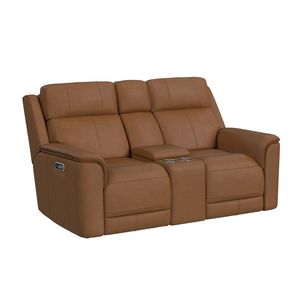
Best apartment-scale leather option. A loveseat is the format for a room that cannot carry a full sofa, and this one pairs a leather covering with power reclining so you keep the function without the footprint. Butternut sits in the warm mid-tone range that this guide identified as the most forgiving color family, hiding both the dust that shows on dark hides and the soil that shows on light ones. Power reclining also means no side lever to clear, which matters when the piece sits close to a wall or an end table. It suits a condo, a small family room, or a second seating piece beside a sofa.
Top Features
- Leather covering: A genuine hide surface rather than a fully synthetic one, worth confirming grade on in the showroom.
- Power reclining: Motorized adjustment with infinite positions and no side lever to clear.
- Butternut mid-tone: In the most forgiving color range for hiding dust and soil.
- Loveseat scale: Fits rooms where a full-length sofa would crowd the walkway.
Homelegance® Laconia Leather Silver Double Power Reclining Sofa and Power Reclining Loveseat
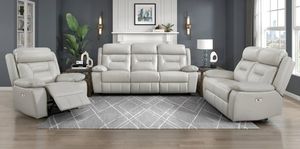
Best for large families. Buying the sofa and loveseat together is the most efficient way to seat a crowd, and this leather set delivers double power reclining on the sofa plus a power reclining loveseat, which means five reclining positions across two pieces. That answers the household scenario where several people want to put their feet up at once, rather than negotiating over one recliner. The silver tone reads modern and cool, so it suits rooms with gray flooring and white trim rather than warm oak. Ask our team about mechanism warranty terms, since mechanisms are the most common claim on any reclining set.
Top Features
- Sofa and loveseat set: Two coordinated pieces bought together for maximum seating.
- Double power reclining sofa: Both outside seats recline independently under power.
- Leather covering: Real hide surfacing rather than a fully synthetic upholstery.
- Silver cool tone: Suits rooms with gray flooring, white trim, and cooler palettes.
Avanti Power Reclining Console Loveseat with Power Headrests
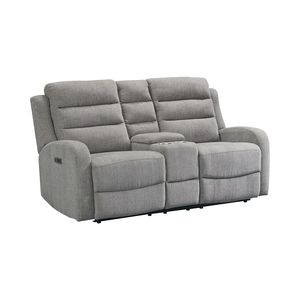
Best feature set in a small footprint. Power headrests are the upgrade that turns a reclined seat into a usable one for watching a screen, since without them a fully reclined position points your face at the ceiling. This console loveseat pairs that with a center console, which converts the middle of the piece into storage and a drink surface rather than a third seat nobody uses. That combination is genuinely hard to find at loveseat scale. Confirm the covering material and grade with our team when you visit, and work the headrest through its full travel while you are sitting in it.
Top Features
- Power headrests: Independent head support that makes a reclined seat usable for television and reading.
- Center console: Storage and a flat surface built in where a side table would otherwise be needed.
- Power reclining: Motorized adjustment on both seats with infinite positioning.
- Compact configuration: A full feature set in a footprint that fits smaller rooms.
Avanti Power Reclining Sofa and Power Reclining Console Loveseat with Power Headrests
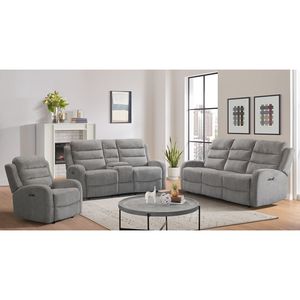
Best fully loaded reclining set. Scaling the Avanti configuration up to a sofa and console loveseat gives you the most reclining positions and the most adjustability of anything in this lineup, with power headrests across the set. For a great room in a newer Lumberton or Mount Laurel home, that combination fills a large space and gives everyone their own seat and their own adjustment. Because power seating needs an outlet, plan the wall before delivery and ask about wall clearance, since even wall-hugger designs need a few inches to travel. Our team can confirm the covering and the mechanism warranty before you order.
Top Features
- Sofa and console loveseat set: Maximum reclining seat count across two coordinated pieces.
- Power headrests throughout: Every reclining seat adjusts head support independently.
- Center console on the loveseat: Built-in storage and a drink surface.
- Great room scale: Sized to fill an open living space rather than disappear in it.
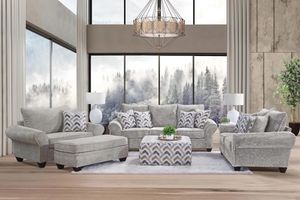
Behold™ Home Arlington Beige Sofa
Shop Living Room Standard Sofas
Best stationary alternative to compare against leather. Not every room needs a mechanism, and a stationary sofa gives you a cleaner silhouette, fewer parts to service, and usually more usable seat width for the same overall length. The beige covering sits in the light-neutral range, which brightens a room fighting for daylight and reduces the visual weight of a full-length sofa. Sit on it back to back with a leather piece on the same visit, because the difference in seat feel and back support between coverings is something only your body can judge. Confirm the upholstery and frame details with our team.
Top Features
- Stationary construction: No mechanisms, which means a cleaner profile and fewer service points.
- Beige neutral covering: A light tone that opens up a room with limited natural light.
- Full sofa seating: More usable seat width than a comparable reclining sofa of the same length.
- Direct comparison piece: Worth sitting on alongside a leather option to feel the difference.
Benchcraft® Erinslane Dusk Sofa
Shop Living Room Standard Sofas
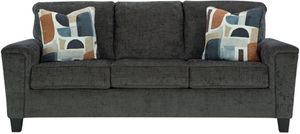
Best mid-tone everyday choice. Dusk lands in the forgiving middle of the value range this guide has recommended throughout, hiding dust better than a dark covering and soil better than a light one, which is the practical requirement for a room used every evening. A stationary sofa also sidesteps the mechanism question entirely, and mechanisms are where reclining furniture generates the most warranty claims over a decade. That makes this a low-maintenance option for a busy family room. Ask our team about the covering and the cleaning code so you know what a spill on it actually requires.
Top Features
- Dusk mid-tone covering: In the forgiving range that hides both dust and soil.
- Stationary sofa: Nothing to service, which suits a heavily used family room.
- Everyday durability focus: Built for daily use rather than occasional seating.
- Easy to coordinate: A neutral base that works with changing rugs and pillows.
Benchcraft® Heartcort Quartz Sofa
Shop Living Room Standard Sofas
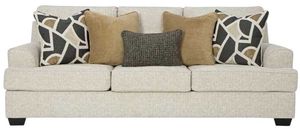
Best light and airy option. A quartz covering is the brightest choice in this lineup, and it does real work in the north-facing living rooms and interior great rooms common in older South Jersey homes, where reflected light is in short supply from November through March. Light upholstery also makes a full-length sofa read smaller, which helps in a room where the seating has to share space with a dining area. The honest trade-off is maintenance, so this is the piece where a protection plan conversation and a clear cleaning code genuinely matter. It suits a formal living room or an adults-only household.
Top Features
- Quartz light covering: Brightens rooms that fight for natural light in winter.
- Reduced visual weight: A light tone makes a full-length sofa read smaller in a shared space.
- Stationary construction: A clean silhouette with no mechanisms to maintain.
- Formal room fit: Best in spaces with lighter daily traffic and fewer spills.
Leather grade and finish set the character of the piece, deciding how soft it feels, how it handles sun and spills, and whether it develops patina or just wears out. The frame, the suspension, and the cushion cores set the lifespan, and those are the parts nobody photographs. The best brand is not a name on a list; it is the one whose materials, warranty terms, and parts availability match the way your household actually lives.
Come sit on them. Shop leather sofas online at Jaron’s Furniture Outlet or visit our Bordentown or Lumberton showroom to compare hides side by side, run the one-minute grade test on any piece, and feel the difference between eight-way hand-tied and sinuous suspension in your own back. Our team can explain the grade and construction on everything we carry, we offer financing, and our own crews handle delivery and setup, with local service and parts support long after the sale. That combination of product knowledge, hands-on evaluation, and follow-through is what an independent South Jersey retailer offers instead of a photograph, a shipping estimate, and a return policy you cannot practically use.
Frequently Asked Questions About Leather Sofa Brands
Top grain leather with a pigmented or semi-aniline finish is the best choice for most households, since it delivers most of the softness and lifespan of full grain while resisting the stains and fading that damage unprotected hides. Full grain is the strongest and most breathable option and suits formal, low-traffic rooms where its aniline finish will not face daily spills or direct sun.
A well-built leather sofa with a top grain or full grain hide over a kiln-dried hardwood frame should last fifteen years or more, and many stay in service considerably longer with routine care. Bonded leather commonly cracks and peels within two to three years of regular use, which is why the material behind the word leather matters more than the word itself.
Full grain is the complete outer layer of the hide with its natural grain intact and nothing sanded away, while top grain is that same outer layer with the surface lightly sanded and buffed to remove imperfections before finishing. Full grain is stronger, more breathable, and develops a richer patina, and top grain is more uniform in appearance and typically more stain resistant once finished.
Leather match is worth buying when the sofa sits against a wall, since the seating surfaces you touch are genuine leather and only the outside back and sides are a coordinated synthetic. It is a poor value on a piece that floats in the middle of a room where every surface is visible and handled, and it is only a fair deal when the seating surfaces are genuine top grain.
Leather sofas work well in homes with pets because hair does not weave into the surface and spills wipe off rather than absorbing, but claw punctures are permanent in a way that fabric snags often are not. Choose a pigmented or protected finish in a textured or pebbled mid-tone, since the pigment layer takes the scratch and the texture hides the marks that do appear.
Most leather sofas need conditioning roughly twice a year, more often in a very dry climate or a room with winter forced-air heat, and less often on heavily pigmented finishes that are already well sealed. Over-conditioning is a genuine problem, since excess product sits on the surface, attracts dust, and can leave a tacky film, so apply sparingly and use a product matched to your finish.
Why Trust Jarons Furniture Outlet?
Jarons Furniture Outlet has been proudly serving New Jersey families since 1992, providing quality furniture and mattresses at prices designed to fit real household budgets. As a locally owned and operated furniture retailer, Jarons understands the needs of homeowners throughout Mercer and Burlington Counties and surrounding communities. Their philosophy is simple: you don't need to spend a fortune to create a comfortable, stylish home.
What sets Jarons apart is their commitment to delivering value, selection, and personal service. Customers shopping for furniture in Bordentown, NJ will find two convenient showroom locations — including one right in Bordentown — where thoughtfully arranged room displays make it easy to envision furniture in their own homes. Whether you're furnishing a new house or refreshing a single room, the Jarons team is ready to help you find pieces that match your style, space, and budget.
Jarons is also known for its "Jaronteed" pricing promise, which focuses on providing some of the best value in the area. If customers find the same product at a lower price within a specified period, Jarons will match it — ensuring shoppers in Bordentown feel confident they're getting a competitive deal on furniture.
Inside the Bordentown showroom and online, you'll find a wide selection of living room furniture, bedroom sets, dining room collections, mattresses, and more. Their knowledgeable sales team works closely with customers to help select pieces that fit both their design vision and practical needs, while delivery and setup services make the furniture buying process in Bordentown simple and stress-free.
Shop Leather Sofas in Bordentown, NJ at Jarons Furniture Outlet
Looking for the perfect furniture for your Bordentown home? Visit Jarons Furniture Outlet today to explore a large collection of stylish, affordable furniture options. Whether you prefer shopping online or visiting their welcoming Bordentown showroom in person, the Jarons team is ready to help you find exactly what you need to complete your space.
With a wide selection of in-stock furniture and helpful design guidance, upgrading your Bordentown home has never been easier. Stop by their New Jersey showroom or browse their selection online to discover pieces that bring comfort, style, and value to your home.