
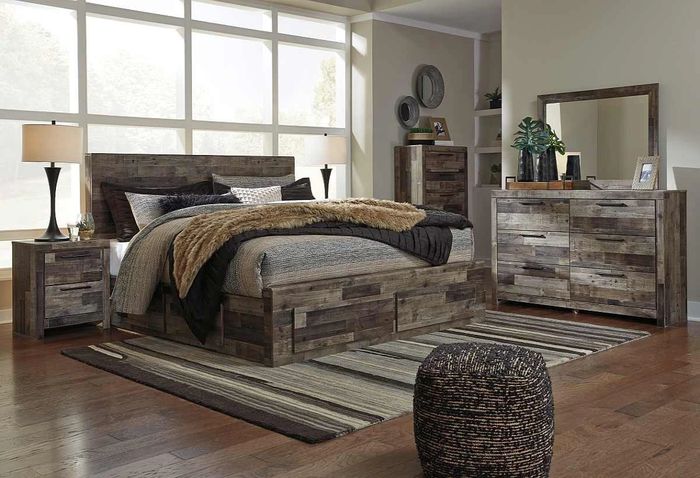
The room gets painted, the new comforter comes out of its packaging, and the space still looks like nobody ever finished it. The mattress sits low on a plain metal frame, the pillows slump backward against bare drywall, and every piece of art added to the walls somehow makes the problem more obvious instead of less. Nothing anchors the room. That missing anchor is almost always the bed itself, which is why a panel bed keeps turning up in the bedrooms that do look pulled together, with a tall paneled headboard, a matching footboard, and side rails that turn a mattress into real furniture.
Here is the good news for anyone shopping right now: this is a solved problem, and the answers come down to a handful of measurements and one honest decision about storage. At Zeglin’s Home TV & Appliance, we help shoppers work through this every week, from first tape measure to delivery day. This guide covers what actually defines a panel bed, how the style compares against platform and sleigh beds, whether you need a box spring or whether slats alone will do, wood versus upholstered panels, sizing and proportion for your specific room, how to build a coordinated bedroom set around the bed, and six beds worth comparing before you buy.
Find the Bed That Finally Makes Your Bedroom Look Finished
Our team matches beds to real room measurements, real mattresses, and finishes you can compare side by side in person. Shop bedroom furniture with local delivery, in-home setup, and financing available.
Explore panel bedKey Takeaways
- A panel bed is defined by its frame, not its finish: A paneled headboard, a lower matching footboard, and connecting side rails carrying slats or a foundation is what makes a bed a panel bed, whether it is oak, whitewash, or upholstered.
- Support type is the specification that matters most: Traditional panel beds are built around a box spring or foundation, while newer low-profile versions include a full slat deck, and guessing from the photo is how people end up with a bed that sits too tall.
- Storage drawers need side clearance to open: Under-rail drawers typically need 20 to 30 inches of pull-out room on whichever side they open, which is exactly the measurement small bedrooms cannot spare.
- Finish changes how big the room feels: A light headboard blends into a painted wall and keeps a small bedroom open, while a dark one reads as a deliberate focal point and visually shortens the wall behind it.
What Is a Panel Bed? Frame Anatomy and Defining Features
A panel bed is a bed built from three connected parts: a paneled headboard, a lower matching footboard, and side rails that link them together. The mattress is carried inside those rails, either by wood slats or by a foundation resting on rail cleats, which is the detail that separates this style from a solid-deck platform frame.
Take the pieces one at a time and the spec sheets stop being confusing.
- Headboard: the tall vertical element, usually made of framed panels with molding, planking, or a padded insert.
- Footboard: the shorter matching piece at the foot, which visually closes the bed and holds the rails square.
- Side rails: the long members that connect headboard to footboard and carry the weight of everything above.
- Slats or slat roll: the cross pieces spanning the rails, either loose wood slats or a hinged roll that lays out in one motion.
- Center support rail and legs: a lengthwise beam with legs reaching the floor, required on queen and larger sizes.
- Foundation or box spring: the flat support box that sits inside the rails on traditional builds and carries the mattress.
The name comes straight from the headboard construction. Flat recessed panels set inside a frame are the original version. Raised panels with beveled edges and applied molding read more formal, plank and shiplap fronts read farmhouse, arched and camelback tops soften the top line, and upholstered panels with nailhead trim swap wood for fabric while keeping the same framed geometry.
Worth stating plainly: a panel bed is a style category, not one product. The same silhouette shows up in traditional collections with cherry finishes, in transitional collections with flat panels and clean edges, in farmhouse groups with whitewash and plank fronts, and in coastal lines with pale gray and white.
Here is the design payoff most guides skip. A taller headboard and a defined footboard frame the bedding on two sides, so the quilt, the shams, and the throw all read as an intentional arrangement instead of loose fabric on a slab. That framing effect is why a made bed photographs well in a panel frame and looks slightly unfinished in a low open one.
Read more:
Panel Bed vs Platform Bed vs Sleigh Bed: How the Styles Differ
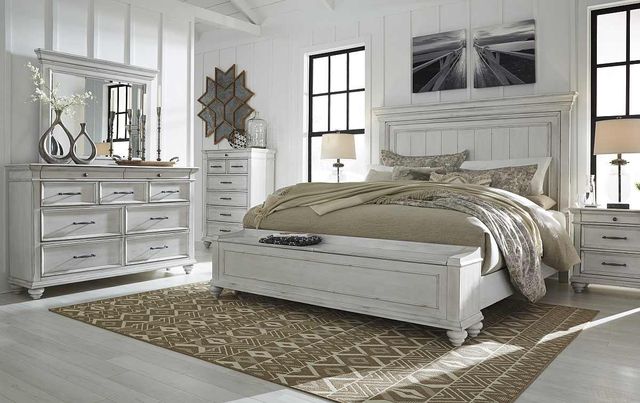
Start with the comparison people actually search for. A platform bed carries the mattress directly on closely spaced slats or a solid deck and skips the box spring entirely. A traditional panel bed is built to hold a foundation inside the rails, and the foundation carries the mattress.
That structural difference shows up as height, which is the part shoppers feel. Platform decks commonly sit somewhere around 10 to 14 inches off the floor, putting the sleep surface in the low twenties once a mattress goes on. A panel bed with a standard foundation usually places the sleep surface closer to 16 to 24 inches at the deck plus the mattress on top, which many adults find easier to sit down on and stand up from.
Panel Beds Compared With Sleigh Beds
A sleigh bed uses curved, scrolled headboard and footboard shapes that roll outward at the top and bottom, like the ends of an old sled. A panel bed keeps those same surfaces flatter and squarer. The practical consequence is footprint: those outward curves push a sleigh bed several inches longer overall than a panel bed built for the same mattress, which matters in a room where the foot of the bed is already close to a dresser.
Storage Beds and Captain’s Beds as Variations
Panel storage beds and captain’s beds are the same silhouette with a drawer base underneath. The drawer unit usually replaces the box spring completely, since the drawers occupy the space a foundation would fill. That changes your mattress math, because the deck sits higher to begin with, and a thick hybrid on top can push the sleep surface uncomfortably tall.
Match the style to the room and the mattress rather than to a mood board:
- Traditional or transitional bedroom with an innerspring mattress: a classic panel bed with a foundation is the natural fit.
- Compact room with low-profile memory foam: a platform or low-profile panel bed keeps the proportions right.
- Large primary bedroom with generous walking lanes: a sleigh bed carries the space without crowding it.
- Bedroom with one shallow closet: a panel bed with storage drawers earns its floor space.
One caution that saves returns. Many current collections are sold as low-profile or panel-platform hybrids, meaning they look like a traditional panel bed but include a full slat system and need no foundation at all. Confirm the support type on the specification sheet instead of assuming from the photograph.
Panel Bed vs Platform, Sleigh, and Storage Beds Compared Side by Side
Find the row that matches how you live and read across. Every figure here is a typical range across collections rather than a promise, so confirm the exact numbers on the product page before you order.
| Bed Style | Support Type | Typical Mattress Height Off the Floor | Box Spring or Foundation Needed | Best Mattress Match | Storage Potential | Room Style Fit |
|---|---|---|---|---|---|---|
| Traditional Panel Bed | Foundation inside rails | 22 to 30 inches | Usually yes | Innerspring and hybrid | Open space underneath | Traditional and transitional |
| Low-Profile Panel Bed | Built-in slat deck | 18 to 24 inches | Usually no | Foam and hybrid | Low | Transitional and farmhouse |
| Platform Bed | Slats or solid deck | 16 to 22 inches | No | Memory foam and latex | Low to moderate | Modern and compact rooms |
| Sleigh Bed | Foundation inside rails | 22 to 30 inches | Often yes | Innerspring | Low | Traditional primary suites |
| Panel Storage Bed with Drawers | Drawer base replaces foundation | 20 to 28 inches | Usually no | Foam and hybrid | High | Small rooms and kids’ rooms |
| Upholstered Panel Bed | Slats or foundation, varies | 20 to 28 inches | Sometimes | Any, confirm the deck | Low | Transitional and glam |
Use this second table when you are matching a bed size to the room it has to live in. The footprint figures account for rails, posts, and headboard depth, which always add inches beyond the mattress.
| Mattress Size | Standard Mattress Width and Length | Typical Overall Panel Bed Footprint | Minimum Recommended Room Size |
|---|---|---|---|
| Twin | 38 by 75 inches | About 42 by 82 inches | 7 by 10 feet |
| Full | 54 by 75 inches | About 58 by 82 inches | 10 by 11 feet |
| Queen | 60 by 80 inches | About 65 by 88 inches | 10 by 12 feet |
| King | 76 by 80 inches | About 81 by 88 inches | 12 by 12 feet |
| California King | 72 by 84 inches | About 77 by 92 inches | 12 by 13 feet |
Read the rows against your own situation and the winners sort themselves out. A couple furnishing a formal primary bedroom with an innerspring set gets the most out of a traditional panel bed and a foundation. Someone squeezing a bed into a spare room with one shallow closet is better served by a storage version, provided the drawer clearance works. A reader or television watcher who wants a headboard that is comfortable to lean against should be looking at upholstered panels, not wood ones.
Do Panel Beds Need a Box Spring? Foundation and Slat Support Rules
Most traditional panel beds do need a box spring or a flat foundation, because the rails are built with cleats to hold one and the slat system alone is not designed to carry a mattress. Newer low-profile panel beds are the exception, since they ship with a complete slat deck and need nothing underneath the mattress.
Checking your own frame takes about two minutes:
- Count the slats and measure the gap between them with a tape.
- Look underneath for a center support rail running head to foot, and check whether it has legs that reach the floor.
- Read the manufacturer’s stated foundation requirement on the listing or in the assembly instructions.
- Compare that requirement against your mattress warranty language before you buy either one.
Slat spacing decides whether foam survives. Gaps of roughly 3 inches or less protect foam and hybrid mattresses from settling into each opening, and most mattress warranties spell out a maximum gap along with a center support requirement. An innerspring mattress riding on a proper foundation is far more forgiving, which is part of why the traditional pairing has lasted so long.
Your Support Options and What Each One Costs You
- Standard box spring: roughly 9 inches thick, the traditional match for a panel bed, and the tallest option.
- Low-profile box spring: usually around 5 inches, the right call when your mattress is already thick.
- Slatted or solid platform foundation: rigid flat support with no give, good for foam and hybrids.
- Bunkie board: a thin solid panel that adds a firm deck without adding meaningful height.
- Bed slat conversion kit: closer-spaced slats added to an existing frame so it can skip the foundation. (See options)
Now the arithmetic almost nobody writes down. Total sleep height equals rail deck height plus foundation thickness plus mattress thickness. Run that sum before you order, and keep the finished mattress top low enough that several inches of headboard panel still show above the pillows and the footboard is still visible. A 14-inch hybrid on a 9-inch box spring inside a tall traditional frame can swallow a headboard that looked dramatic in the showroom.
Three mistakes account for most complaints. Skipping the center support legs on a queen or king puts load on rails never designed to carry it, and a sag line down the middle follows. Forcing a box spring into a frame built as a platform raises the bed to an awkward climb. Pairing the thickest mattress you can find with the tallest foundation available buries the design detail you paid for.
Here is the setup detail our delivery team watches on every bed: snug the rail-to-headboard and rail-to-footboard bolts during assembly, but save the final tightening until the foundation and mattress are in place and the frame is carrying weight. Tightening an empty frame lets the joints shift once real load arrives, and that shift is where the squeak starts. Many furniture warranties specifically exclude damage traced to loose hardware, so a five-minute pass with a hex key at the end of setup protects the coverage.
Wood, Upholstered, and Mixed-Material Panel Bed Styles
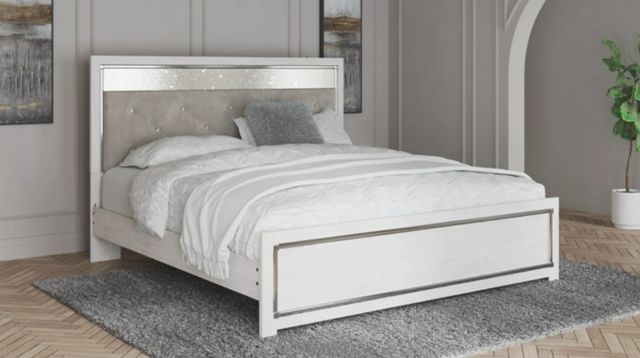
Material sets the personality of the bed more than the silhouette does. The same paneled shape can read rustic, coastal, formal, or soft depending entirely on what it is made of and how it is finished.
Solid Wood and Veneer Panel Beds
Shoppers see a lot of species names on tags: oak, acacia, rubberwood, poplar, and pine, along with engineered wood carrying a wood veneer. Finish language matters just as much, with rustic brown, weathered gray, whitewash, espresso, and warm cherry all doing very different jobs in a room.
Solid wood resists dents, holds hardware tightly, and can be refinished decades later. Veneer over engineered panels costs far less and can look beautiful, but it cannot be sanded back and it suffers if water sits on it. On matching case pieces, look for corner block construction, English dovetail joinery on drawer boxes, and hardware finishes that repeat across the collection.
Upholstered Panel Beds
An upholstered panel bed swaps wood panels for a padded insert, which is the practical answer if you read or watch television in bed. Fabric choice drives how it ages. Performance fabrics resist stains and clean easily, linen-look weaves keep the room casual, velvet looks rich but shows crushing where you lean, and faux leather wipes clean in seconds.
Detailing changes the mood again. Channel tufting runs vertical lines up the panel and reads current, button tufting is more formal and collects crumbs in the buttons, and nailhead trim outlines the panel with a tailored edge. In a house with pets, smooth tight weaves shed hair better than textured or looped fabrics.
Mixed-Material Designs
Plenty of current beds combine a fabric insert with a wood or metal surround, giving you a padded place to lean without committing the whole bed to upholstery. These read transitional and tend to coordinate easily with wood dressers you already own.
Detail level is the fastest way to place a bed stylistically. Raised panels with applied molding read traditional. Plank and shiplap fronts read farmhouse. Flat panels with clean square edges read transitional. Padded panels with nailhead trim read soft and dressy.
One caveat on finishes: whitewash, weathered gray, and charcoal all shift noticeably under warm bulbs versus daylight, and photographs on a screen rarely tell the truth about undertone. Comparing samples in person under real light is the only reliable way to know whether a whitewash bed will read cream or gray against your walls.
Panel Bed Pros and Cons Every Shopper Should Weigh
The trade is straightforward once it is named. A panel bed buys you presence, comfortable height, and a coordinated style direction, and it asks for floor space, a foundation, and a room that suits its look in return. Here is the honest accounting.
Pros
A real visual anchor for the room
The tall headboard and matching footboard frame the bedding on two sides, which is what makes a made bed look finished rather than loose.
Easier sit-and-stand height
A foundation inside the rails puts the sleep surface higher than most platform beds, which many adults with knee or hip complaints strongly prefer.
Coordinated sets are widely available
Nightstands, dressers, mirrors, and chests are usually offered in the same finish and hardware, so a full bedroom can be built over time without hunting for matches.
A price and material range that fits any budget
The same silhouette exists in engineered wood with veneer, in solid hardwood, and in upholstered versions, so the style is not locked to one price band.
Long service life from spread load
A foundation distributes mattress weight evenly across the rails instead of concentrating it, which extends the life of both the mattress and the frame.
Cons
The foundation is a separate cost
Traditional panel beds usually need a box spring or foundation that is not included, adding a few hundred dollars and a second delivery item.
The footprint is larger than the mattress
Rails, posts, and a footboard add inches on every side, and a footboard demands walking clearance at the foot that an open-ended frame does not.
Limited fit with strictly minimalist rooms
In a very modern space with low furniture and clean lines, a tall paneled headboard can look out of step no matter how good the finish is.
Read more:
Sizing, Proportion, and Room Layout for a Panel Bed
Measure before you fall in love with a finish. The method is repeatable and takes about fifteen minutes with a tape and a notepad.
- Measure the wall the bed will sit against, wall to wall, and note the location of windows, vents, and outlets.
- Measure ceiling height, since a tall headboard needs visual breathing room above it.
- Measure the doorway width, hallway turns, stairwell width, and the stair landing where the pieces have to pivot.
- Measure the intended walking lanes on both sides and at the foot.
- Compare all of it against the bed’s overall exterior length including the footboard, not the mattress size.
Aim for roughly 24 to 30 inches of clear floor on each side and at the foot for comfortable traffic, plus room for dresser drawers and closet doors to open fully. Tape the exterior footprint on the floor with painter’s tape and live with it for a day before committing. Headboard height wants a similar sanity check: in an 8-foot room, a headboard that crowds the window sills or reaches near the ceiling will feel heavy, while the same piece looks proportional under a 9-foot ceiling.
Footboard height carries consequences people discover too late. A tall footboard closes the bed visually and blocks the sightline to a dresser-mounted television from a lying position. A low or open footboard keeps a small bedroom feeling longer and gives tall sleepers room to stretch past the mattress edge.
Queen or King, and the Split Foundation Question
For couples, the queen versus king decision is usually about the room rather than the sleepers. A queen panel bed suits rooms around 10 by 12 feet with walking lanes intact, while a king panel bed really wants 12 by 12 feet or more before the room stops feeling like a corridor. Note that king foundations are commonly sold as two split pieces rather than one, which is good news for narrow staircases and worth confirming at purchase.
Adjustable bases come up constantly now, and the answer depends on the frame. An adjustable base needs an open interior with no fixed deck in the way, enough interior rail length and width for the base to sit inside, and clearance for the head section to raise without the footboard interfering with foot articulation. Confirm rail clearance and footboard interference before you order, because most storage panel beds cannot accept a base at all.
Building a Matching Bedroom Set Around Your Panel Bed
The bed sets the direction and everything else follows it. Build in this order and the room comes together without a wasted purchase: bed first, then nightstands, then a dresser with mirror, then a chest if you still need drawer space, then an optional bench or media chest last.
A packaged bedroom set makes sense when you are furnishing an empty room from scratch, when you want the finish to match exactly, and when you want everything to arrive on one delivery. Mixing pieces makes more sense when you already own a dresser you like or when the room is small enough that a full set would overwhelm it.
Proportion Rules That Keep It From Looking Off
- Nightstand height should land within a couple of inches of the mattress top, so a glass of water is not a reach down.
- Dresser width works best at roughly the width of the bed or a little less, sitting on a wall long enough to leave breathing room on both sides.
- A tall chest belongs on a short wall, where a wide dresser would crowd the doorway.
- A bench at the foot needs the same walking clearance the footboard already demanded, plus its own depth.
Perfect matching is not the goal. Stay inside one finish family, repeat the hardware finish across pieces, and then add exactly one contrasting piece, such as an upholstered bench or a painted nightstand, so the room looks collected instead of catalog-flat.
Bedding deserves a note too. A paneled headboard is already doing decorative work, so it needs fewer pillows than a plain frame does. Two euro shams, two sleeping pillows, and one accent is usually plenty. Layered quilts and a folded throw at the foot flatter the framing effect, and hanging drapery high and wide keeps the wall from competing with the headboard.
At Zeglin’s Home TV & Appliance, our team can pull finish samples side by side in the showroom, confirm which case pieces belong to the same collection, and sequence a bedroom that gets assembled in stages so the budget spreads out. Delivery includes in-home setup and removal of the old bed, which matters more than shoppers expect on the day a foundation has to come up a staircase.
The Drawer Clearance Math That Decides Whether a Storage Bed Fits
Under-bed drawers are the most useful upgrade in a room with one shallow closet, and they are also the single most common fit mistake we see. The issue is not the bed’s footprint, it is the pull-out arc. A side drawer has to travel almost its full depth to be usable, so a drawer roughly 20 inches deep needs about 20 to 30 inches of open floor beside the bed to fully extend, and you have to be able to stand in that same space while you use it. Push a storage bed against a wall on one side to save room and you have paid for drawers you can only open halfway. Bench storage at the foot changes the geometry completely, because the clearance you need is at the end of the bed where you already had to leave a walking lane. That single distinction decides which storage style belongs in your room.
Run this check before choosing a storage configuration:
- Measure the open floor on each side of the bed, from rail to wall or to the nearest fixed obstacle, and compare it against the drawer depth listed for the bed.
- Confirm which side the drawers are on, since many storage beds are configurable at assembly and cannot be switched later.
- Check whether a nightstand, radiator, floor vent, or door swing sits inside the pull-out zone.
- For bench or footboard storage, measure the clearance at the foot instead and add the depth of the lid or drawer travel.
- Remember that a drawer base usually replaces the box spring, so recalculate total sleep height before choosing a mattress.
- Ask about drawer weight limits if you plan to store books or dense winter bedding rather than clothing.
Read more:
- 6 Benefits of Sealy Posturepedic Mattresses
- Best Appliance Stores in Davenport, Iowa: Why Locals Choose Zeglin’s
Top Panel Beds and Bedroom Pieces at Zeglin’s Home TV & Appliance
The six beds below answer genuinely different questions, from maximum drawer storage to a padded headboard built for reading. Three offer storage in three different configurations, one trades wood for upholstery, and two are classic non-storage frames that show how much the finish alone changes a room. All are available with local delivery, professional in-home setup, and removal of your old bed, with financing available.
Benchcraft Derekson Multi Gray Queen Panel Bed with 6-Drawer Storage
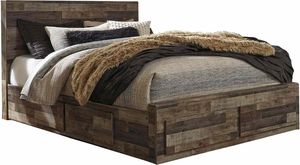
Older bedrooms with one shallow closet and no built-ins are the exact problem this bed solves. Six drawers built into the base turn dead floor space under the mattress into real storage for off-season clothing and spare bedding. The multi gray plank-front finish keeps the look casual and farmhouse rather than formal. Apply the clearance math from the previous section before you order, since side drawers need open floor to fully extend on whichever side they are installed. Queen sizing suits a bedroom around 10 by 12 feet with walking lanes intact.
Top Features
- Six-drawer storage base: Replaces a dresser’s worth of capacity in a room that has nowhere else to put clothing.
- Multi gray plank styling: A rustic farmhouse face that pairs easily with white trim and wood floors.
- Queen panel format: A familiar footprint that fits most standard bedrooms without crowding the doorway.
- Drawer base instead of a box spring: Recalculate total sleep height with the mattress alone, since no foundation goes inside.
Benchcraft Kanwyn Whitewash King Panel Bed with 1 Bench Storage
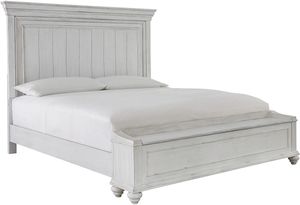
When side drawers would open straight into a walkway or a nightstand, storage at the foot is the smarter answer. This king bed puts a storage bench at the end of the frame, so the clearance it uses is the walking lane you already had to leave. The whitewash finish keeps a large bed from feeling heavy, softening the visual weight a king normally brings into a room. Plan on roughly 12 by 12 feet of bedroom before traffic gets tight, and ask about the split foundation option, which handles narrow staircases far better than a single piece.
Top Features
- Bench storage at the foot: Adds capacity without demanding side clearance, which suits rooms with a tight walkway.
- Whitewash finish: Lightens the presence of a king-size frame and blends with painted walls and light flooring.
- King sizing: Real sleeping width for couples, best in bedrooms measuring about 12 by 12 feet or larger.
- Doubles as seating: The bench gives you a place to sit while dressing without adding another piece of furniture.
Signature Design by Ashley Altyra White King Upholstered Panel Bed
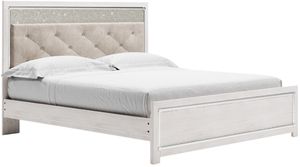
Reading in bed or watching a show before sleep stops being pleasant against a hard wood panel after about a week. This bed answers the headboard comfort question with a padded upholstered panel you can actually lean into, in a clean white that works with almost any existing dresser finish. King width gives two people room to sit up without crowding each other. Follow the upholstery care guidance covered earlier, vacuuming the panel with a brush attachment and blotting rather than scrubbing spills, and ask about a fabric protection plan in a house with kids or pets.
Top Features
- Padded upholstered headboard: Comfortable back support for reading and screen time that a flat wood panel cannot match.
- Clean white finish: Neutral enough to sit alongside warm or cool wood tones without a full bedroom refresh.
- King proportions: Wide enough for two people to sit up comfortably, suited to larger primary bedrooms.
- Straightforward fabric care: Routine vacuuming and prompt blotting keep the panel looking new for years.
Signature Design by Ashley Cambeck Whitewash Queen 2-Drawer Storage Panel Bed
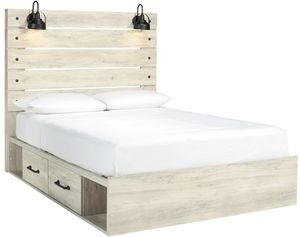
Two drawers is the middle ground for rooms that need extra storage but cannot spare clearance on both sides of the bed. You get meaningful capacity for bedding and off-season clothes while keeping the pull-out zone limited to a single side, which is easier to plan around a nightstand or a closet door. The whitewash finish reads coastal and farmhouse at once and brightens a room with limited natural light. Queen sizing keeps the exterior footprint manageable. Confirm which side the drawers install on before delivery day.
Top Features
- Two-drawer storage: Useful capacity without committing both sides of the room to pull-out clearance.
- Whitewash finish: Reflects light in darker bedrooms and coordinates with painted trim and light wood tones.
- Queen footprint: A practical fit for bedrooms around 10 by 12 feet with walking lanes preserved.
- Configurable drawer side: Choose the side at assembly to match your room layout, since it cannot be swapped later.
Signature Design by Ashley Belachime Charcoal Queen Panel Bed
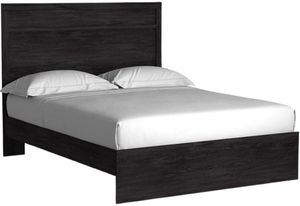
Skip the storage entirely and the finish becomes the whole decision. A charcoal headboard advances visually against a light wall, which turns the bed into the clear focal point and makes a larger bedroom feel more intimate and grounded. That same effect can shorten the visual depth of a very small room, so this one rewards a bedroom with a bit of breathing space. The classic panel silhouette works with the traditional and transitional case pieces most people already own. Confirm the support requirement so you pair the right foundation with your mattress.
Top Features
- Charcoal finish: Creates a deliberate focal point and grounds a room with light walls and pale flooring.
- Classic non-storage design: Keeps open floor under the bed for cleaning, air movement, or storage bins.
- Queen sizing: The most common bedroom size, easy to match with standard bedding and nightstand heights.
- Coordinated collection pieces: Nightstands and dressers in the same finish family make building a set simple.
Signature Design by Ashley Stelsie White Queen Panel Bed
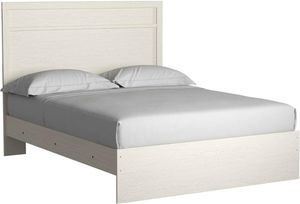
Compare this one directly against the charcoal option above and the point about finish becomes obvious. A white headboard recedes toward a painted wall instead of standing apart from it, so the bed keeps its framing effect while the room reads larger and more open. That makes it a strong choice for a smaller bedroom, a guest room, or any space with limited natural light. The simple panel styling stays quiet enough to let bedding and artwork carry the color. Queen sizing fits standard rooms and standard sheets without special ordering.
Top Features
- White finish: Visually recedes against light walls, which keeps a small bedroom feeling open rather than crowded.
- Simple panel styling: A quiet backdrop that lets bedding, drapery, and artwork provide the color in the room.
- Queen size: Fits standard bedrooms and standard bedding, with no special-order sheets required.
- Open under-bed space: No drawer base means no side clearance requirement and easy access for cleaning.
Your Classic Bedroom Starts With the Right Panel Bed
A panel bed earns its place by framing the bedding, sitting at a height most adults find comfortable, and giving a room a style direction the rest of the furniture can follow. Get the support type right, run the height arithmetic before you choose a mattress, leave real clearance on the sides and at the foot, and the bed will still look correct a decade from now. Storage is the one decision that has to be made against a tape measure rather than a photo.
Shop panel beds and bedroom furniture at Zeglin’s Home TV & Appliance online, or bring your room measurements in and compare finishes side by side under real light. Our team can tell you which beds need a foundation and which do not, help you match a mattress to the frame honestly rather than upselling both, and arrange local delivery with in-home setup and old bed removal instead of leaving cartons in the driveway. Financing is available, and when you need a replacement slat or a service call two years from now, you are calling the same local store that sold you the bed rather than a call center. That is the difference between buying from an independent retailer and clicking through a checkout page.
Frequently Asked Questions about Panel Beds
A panel bed is built from a paneled headboard, a matching lower footboard, and side rails that hold either slats or a foundation, while a platform bed carries the mattress directly on a built-in slat or solid deck. The practical difference is height and support, since a traditional panel bed usually needs a foundation inside the rails and a platform bed never does.
Most traditional panel beds are designed around a box spring or flat foundation, though newer low-profile panel beds include a full slat deck that supports the mattress on its own. Check the manufacturer’s stated foundation requirement on the listing, because the two versions look nearly identical in photographs.
A well-built solid wood panel bed commonly lasts 15 to 25 years, while engineered wood with veneer generally shows wear closer to the 5 to 10 year mark. Joinery quality, center support legs that reach the floor, and periodic bolt tightening matter far more to lifespan than the original price tag.
Yes, a bed slat conversion kit or a bunkie board can replace a box spring in most panel beds by adding closely spaced support inside the rails. Confirm that the rails have cleats able to carry the added slats and that your mattress warranty accepts the resulting gap spacing.
Plan on roughly 24 to 30 inches of open floor on each side and at the foot for comfortable walking and for dresser drawers to open. Storage versions need more on the drawer side, typically 20 to 30 inches of pull-out room measured from the rail to the nearest obstacle.
Many do, as long as the frame has an open interior with no fixed deck and the interior rail dimensions exceed the base measurements. Confirm rail height and whether the footboard interferes with foot articulation, since storage panel beds with drawer bases usually cannot accept a base at all.
Why Trust Zeglin’s?
Since 1974, Zeglin’s has been proud to serve the Quad Cities as a trusted, family-owned appliance store. What started as a local business in Davenport has grown into a well-known destination for appliances, mattresses, and home entertainment, built on the values of quality, service, and community.
Shop Panel Beds at Zeglin’s
Our showroom features a wide selection of mattreses from the industry’s most respected brands, along with expertly designed displays to help inspire your home. At Zeglin’s, we believe every customer deserves personalized attention, dependable products, and the confidence of working with a team that cares. That’s why Davenport locals continue to choose Zeglin’s for their homes year after year.